Recipes · All Recipes — A to Z
Ingredients:6-8 medium beets (with tops removed for one week) 3" stick of cinnamon 1" cube of ginger, thinly sliced 4 whole cloves 1 tsp. allspice berries 1 tsp. brown mustard seeds 1 tsp. peppercorns 1 tsp. cardamom seeds zest of one orange (peel with vegetable peeler) juice of one orange Jar: 3 Liter (halve recipe for a 1.5-liter Jar, or approximately double for a 5-liter Jar, including spices and orange peel; adjust the beet quantity to maintain the three-fifths fill level and adequate space for brine) Brine: 2% Brine: 40 grams Himalayan Pink Salt in 2 Liters water 68–78°F, with 68–72°F preferred Ferment: 7-9 days |
|
Preparation:
1. To the Jar, add all ingredients except the beets.
2. Prepare the beets by cutting off the tops and root tip, and scrubbing with vegetable brush to remove all traces of dirt. If beets have been in storage for some time, it is perfectly fine to peel them, but it isn't necessary.
3. Cut beets into cubes that are between about 1" at the thickest part, or 1 1/2" at the thickest part. Beets that are cut too small ferment too quickly, and whole beets that are too large ferment too slowly.
4. Add beets to the Jar, filling it approximately three-fifths full—more than halfway but less than two-thirds full.
5. Add 2% brine to just below the neck of the Jar.
6. Place Brine (Submersion) Bowl, fill & insert the Airlock, lock the Jar & cover.
7. Leave at 68–78°F for 7–9 days, with 68–72°F preferred.
8. Move to the refrigerator and when ready to use, pour the kvass off of the beets into a 2 Liter Jar for use and storage.
Notes:
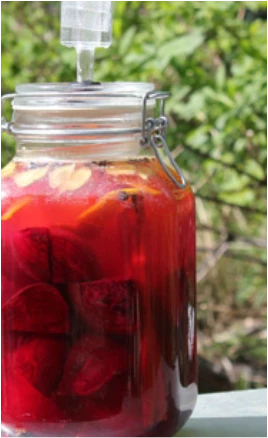
You can adjust the size of the Jar if necessary; the ratio of the beets to brine is most important, and the amount of spices are less important. When the ferment is finished, if you used red beets, the kvass will have a deep red color.Beet Quantity and Flavor
Using too few beets and too much brine can produce little more than salty pink liquid instead of richly flavored beet kvass. Adjust the quantity of beets to maintain the three-fifths fill level and leave adequate space for brine.
Temperature for Kvass
For the countertop phase, use 68–78°F, with 68–72°F preferred. Kvass tolerates this warmer range because it is a beverage rather than a vegetable ferment where crisp texture is the primary objective.
Carbonation & Bottle Safety
Sealing a ferment to create fizz can build dangerous pressure, even during refrigeration. Use only bottles specifically designed for carbonation. Excessive pressure can break even pressure-rated bottles and cause serious injury.
Read moreRead less
If you want carbonation, transfer finished kvass to clean bottles specifically rated for carbonation. Ferment and store the kvass under the Airlock in the Probiotic Jar.
- Carbon dioxide is produced during fermentation. The Probiotic Jar’s Airlock allows gas to escape and is not intended for producing carbonation. Do not use the Stopper to deliberately trap gas and create fizz in the Probiotic Jar.
- Use clean bottles specifically designed for carbonation. Avoid ordinary bottles and jars that are not designed for carbonation.
- Do not overfill carbonation bottles or leave them sealed indefinitely while fermentation continues. Pressure can continue accumulating under refrigeration, and even pressure-rated bottles can fail if pressure becomes excessive.
- Place sealed carbonation bottles in a sturdy, covered secondary container in the refrigerator as an additional precaution. It may provide an additional barrier, but it cannot guarantee containment of broken glass or protection from injury.
Learn more about actual incidents of exploding glass:
Scientific background
Colorado State University Extension — Understanding and Making Kombucha