
Recipes · All Recipes — A to Z
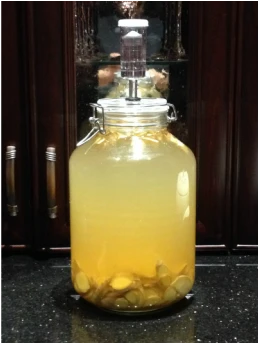
To make Ginger Soda, you will need an ongoing
Ginger Soda "starter" or "bug".
You can drink the starter,
but it tends to be very strongly flavored.
Initial Ingredients:
1/2 Pound Fresh Ginger root
1 cup Ginger Bug
2/3 cup cane sugar
2/3 cup Rapadura
10 grams Himalayan Pink Salt
Juice and zest of 2 lemons or limes
Jar: 5 Liter
Brine: Not Applicable
Temperature: 68º-72ºF
Ferment: 7 Days
Preparation:
1. Clean the ginger root. Trim the dried ends off of the fresh root, since this is where mold starts on ginger. Wash the root, breaking pieces off where necessary to get in to trim the dried ends.2. Slice the ginger root into thin slices, 1/4” or thinner.
3. Add 1 cup of Ginger Bug, 2/3 cup of cane sugar, and 2/3 cup of Rapadura, and 10 grams of Himalayan Pink Salt, and the lemon or lime juice and zest to the Probiotic Jar, and stir with a non-metallic utensil.
4. Fill to just below the neck with filtered water.
5. Float the Brine Bowl on the water, and close the Jar.
6. Fill the Airlock with water and twist into place.
7. Place Jar in 68º-72ºF dark spot for three or four days, and do not open the Jar.
8. After three or four days, open the jar, remove three cups of liquid into a clean container, and slowly add a quarter cup of sugar and a quarter cup of Rapadura. If the mixture bubbles while adding the sugar, then it is ready to bottle (mix the removed liquid back in and go to step 9). If it does not bubble, then add another cup of ginger bug and another half cup of sugar, and another half cup of Rapadura and wait another three or four days (Remove additional liquid if necessary). Pour the reserved liquid back into the Jar to just below the neck and replace the Brine Bowl after you're finished working with it. Discard the excess reserved liquid (or drink it).
9. After the mixture is bubbling when sugar is added, taste the mixture. It should be quite sweet, as it continues to ferment, it will become less sweet as the lactic acid bacteria consumes the sugar. Add enough sugar to make it too sweet, and stir to dissolve with a non-metallic utensil.
10. Strain through cheesecloth and pour into clean bottles specifically designed to withstand pressure from carbonated beverages.
Sealing the bottles allows carbon dioxide to accumulate and dissolve into the liquid, creating the delightful fizz. However, excessive pressure can cause even pressure-rated bottles to break, potentially resulting in serious injury.
For additional protection, place sealed carbonation bottles in a sturdy, covered secondary container during refrigeration. This may provide an additional barrier if a bottle breaks, but it cannot guarantee containment of broken glass or protection from injury.
Never use the Probiotic Jar or ordinary glass jars for this purpose.
11. Release accumulated pressure each day, or every few hours if necessary. When the sweetness is just right (usually a day or two), move the bottles to the refrigerator to chill and serve.
Continue releasing accumulated pressure during refrigerated storage, since fermentation and gas production can continue even at refrigerator temperatures. Releasing pressure reduces buildup but does not guarantee protection against bottle breakage.
Notes:
Liquid Stevia could be added to provide a non-nutritive (probiotic bacteria won't digest it) stable sweetener after it's ready to drink.
Carbonation & Bottle Safety
Sealing a ferment to create fizz can build dangerous pressure, even during refrigeration. Use only bottles specifically designed for carbonation. Excessive pressure can break even pressure-rated bottles and cause serious injury.
Read moreRead less
- Carbon dioxide is produced during fermentation. The Probiotic Jar’s Airlock allows gas to escape and is not intended for producing carbonation. Do not use the Stopper to deliberately trap gas and create fizz in the Probiotic Jar.
- Use clean bottles specifically designed for carbonation. Avoid ordinary bottles and jars that are not designed for carbonation.
- Do not overfill carbonation bottles or leave them sealed indefinitely while fermentation continues. Pressure can continue accumulating under refrigeration, and even pressure-rated bottles can fail if pressure becomes excessive.
- Place sealed carbonation bottles in a sturdy, covered secondary container in the refrigerator as an additional precaution. It may provide an additional barrier, but it cannot guarantee containment of broken glass or protection from injury.
Learn more about actual incidents of exploding glass:
Scientific background
Colorado State University Extension — Understanding and Making Kombucha