
Recipes · All Recipes — A to Z
Granola ~ Raw, Lacto-Fermented, Dehydrated & Gluten FreeJar: 2 Liter Jar
Brine: None Ferment: 2-3 Days Dehydrate: Approximately 36–72 hours at 115°F, or until completely dry throughout Ingredients: 5 1/2 cups raw or cooked gluten-free organic rolled oats 1 1/3 cups unsweetened organic coconut flakes or shreds 1 1/3 cups organic dried gluten-free fruit mixture (dates, raisins, any mix will do) 1 1/3 cups pecans (or slivered almonds or other nuts or seeds you love) 2 tea. Himalayan Pink Salt or sea salt 1 1/3 cup warm water (room temperature) 1 2/3 cup whole-fat grass-fed raw-milk yogurt (or kefir or cultured buttermilk) 1 1/2 tea. cinnamon 1/2 tea. nutmeg or cardamom 1/3 cup local raw honey (or buy at www.alaskawildhoney.com) 1/3 cup butter 1/3 cup coconut oil |
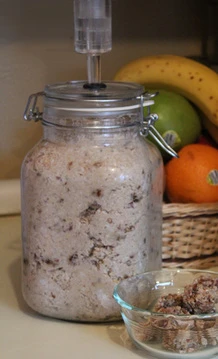
|
Preparation:
- In a non-metallic bowl, mix the oats, nuts or seeds, coconut, fruit, salt, yogurt (or other dairy) and water.
- Mix well.
- Move to a Probiotic Jar, getting out as many air pockets as possible. Lock the lid, twist the Airlock into place with water, and move to a 68-72ºF spot in the dark. Ferment for 2-3 days. The longer it ferments the more sour it will taste, and the more pre-digested it will be when finished.
- After 2-3 days, warm the coconut oil and butter just enough to melt (in a bowl over warm water on the stove top).
- Add the honey and spices to the liquid, and mix well.
- Spoon the oat mixture into a non-metallic mixing bowl, and add the liquid mixture, and mix well. (A polish dough hook works very well).
- If desired, sweeten to taste with Rapadura or Sucanat, or additional honey.
- Spoon cookie-sized chunks onto parchment paper or dehydrator sheets, and begin dehydrating at 115°F overnight. Break the chunks apart into bite-size pieces to expose moist centers. Continue dehydrating for another 36 hours or until completely dry throughout. Check the thickest pieces for any remaining moisture.
- After dehydrating, allow to cool completely before moving to a storage jar. Remaining moisture, especially in the centers of thick pieces, can result in mold.
Stores well in sealed jar (Fido Jars work great!) in pantry for a month or more.
Some people may have a very hard time digesting raw grain, and the fermentation process will do a great amount of pre-digesting of the oats.
About Oat Processing, Fermentation, and Digestibility
We prefer organic oats. Conventional rolled oats are generally heat-treated during processing, commonly through steaming and drying. Whole oat groats may have different processing histories, including whether they have been kilned. Organic certification does not establish whether oats have been heat-treated.
Fermentation can modify some oat components, including starch, proteins, fiber, and phytate, and may influence digestibility. The results depend on the oats, their prior processing, and the fermentation conditions. Fermentation does not reproduce every effect of cooking.
Untreated oats may carry harmful microorganisms. This specific fermentation and low-temperature drying process has not been independently validated to eliminate potential pathogens. The general research linked below is not validation of this particular recipe.
Research and Processing References
- University of Wisconsin–Madison Extension — The Safety of Raw Oatmeal
- Harvard T.H. Chan School of Public Health — Oats
- Whole Grains Council — Can You Eat Raw Grains?
- Djorgbenoo et al. (2023) — Fermented Oats as a Novel Functional Food
- Lambrechts et al. (2026) — Impact of kilning on the fermentability of oat wholemeal flour and related bioconversion of starch, protein, dietary fibre, and phytate
- Blontrock et al. (2025) — Enzyme activity and constituent extractability of kilned and non-kilned oats at pH values relevant for acidic food fermentations
- Fermentable Carbohydrate Reaching the Colon after Ingestion of Oats in Humans (1991)
- Michigan State University — Raw Flour: What’s the Risk?