
Recipes · All Recipes — A to Z
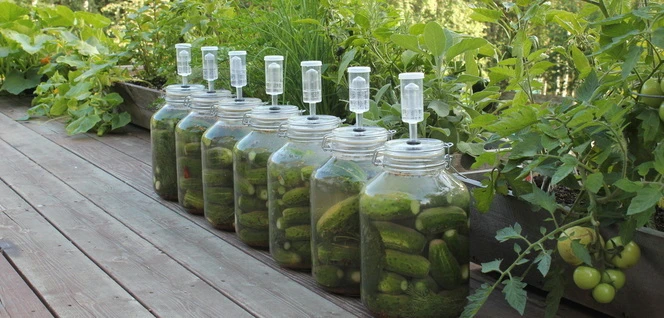
Ingredients:
Freshly picked pickling cucumbers, all roughly the same size. (Don't put big and small cukes in the same jar)2-3 heads of garlic, with cloves & separated, the roots trimmed, and peeled (smack-peeling is fine)
2-3 dill heads (or 4-5 medium sprigs)
Suggested Spice Blend: (Dill pickles with only garlic and dill are delightful; spices totally optional)
5 tsp. coriander seeds
1 tsp. whole cloves
1 tsp. mustard seed
1" of cinnamon stick
1 tsp. allspice berries
1 tsp. peppercorns
1 tsp. fennel seeds
1/2 tsp. red pepper flakes (if you like a little heat, or more, to taste)
1 bay leaf
OR
3 TBS Frontier's Organic Original Spicy Pickling Spice
To promote crunchy pickles:
2 grape leaves, OR
4-5 Raspberry, cherry, or blackberry leaves, OR
2-3 white oak leaves (identifying a white oak tree)
Jar: 5 Liter Jar (For smaller jar, mix dry whole spices as listed above, then use appropriate portion of spices)
Brine: 3.5% Brine for half-sour, or 5% Brine for full sour pickles
Ferment: 7-12 days (Skinny pickles take less time, and large pickles take longer. Also affected by temperature range.)
Temperature: 68-72ºF Ideal Range
Preparation:
(See Quick Start Guide for explanations)- Mix Brine solution.
- Wash and trim ends off of cucumbers (just enough to remove the tips & stem connection), and discard any with soft spots and carve out any blemishes. Do not slice or quarter, as this contributes to mushiness.
- Place herbs and whole spices in the bottom of the Jar (along with the leaves of choice). Or cheat, like I do, and use 3 TBS Frontier's Organic Original Spicy Pickling Spice in place of all but the garlic and dill. This awesome spice blend comes with whole red peppers, which can be removed for a few Jars with less heat, and add them all to one Jar for super heat!
- Tip Jar at an angle to make it easy to pack the cukes in vertically. Press cukes against the sides of the Jar quite firmly to allow more to fit; stuff them in tightly. Alternate the fat end with the skinny end to fill all the gaps possible. In the second layer, fit shorter pickles against the longer ones. Do not allow any cukes to poke up above the shoulder of the Jar, and lay the last few horizontally across the top if there is room below the shoulder. Alternatively, the pickles can stack on their sides and be layered up to the neck of the Jar, whichever method allows for the maximum number of pickles to fit into the Jar.
- Pour 3.5% or 5% brine over the pickles, up to just below the neck.
- Place Brine (Submersion) Bowl, fill & insert the Airlock, lock the Jar & cover.
- Leave at 68–72°F for 7-12 days, a little shorter if a little warmer, a little longer if a little cooler.
- Move to cool storage (60ºF) or refrigerate. When the inside of the pickle is no longer whitish and blotchy, it's completely finished and ready to eat. If using cool storage, after three or four months they should be moved to refrigeration, because after a time they will begin lose some of their crispness.
NOTES:
Cloudiness is normal, and expected with dill pickles. Many fermented vegetables develop cloudiness in the brine, and this is completely normal, unless it's slimy or foul smelling. See Detecting Spoilage if you have more questions.
Our Alaska Experience: We stored our cucumber-dill pickles ~ 6 Large (5 Liter) Jars of them ~ in our well-house this past winter. The well-house hovers at a nice 36ºF in the winter time, and I didn't realize during this hot summer as it was reaching temperatures of 80ºF in the shade, that my well-house had warmed up to 60ºF. I fully expected the rest of last year's sauerkraut and pickles to be soft and to have lost their crunch, but was delighted to find that they were in perfect full-crunch condition, even though they were not rescued until the end of July!
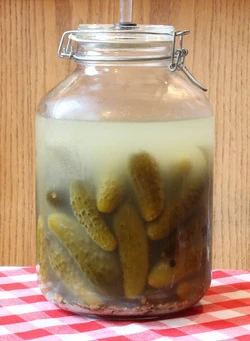
The last Jar of lacto-fermented dill pickles from
August 2012 that we started dipping into in July 2013.