
Recipes · All Recipes — A to Z
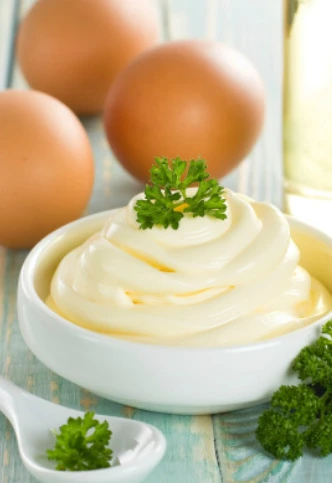
Before we get right into making Mayo, I want to point out a few safety-related ideas. In this recipe, I am using fresh fertilized pastured eggs that were plucked from under the free range healthy hen this very morning. If you are using store-bought eggs, you should have concerns about the safety of using raw eggs including the whites. If you must use store-bought eggs, go for organic eggs that are the freshest you can find, and use two or three yolks instead of one whole egg.
1 large room temperature egg (add water to make 1/4 cup total egg & water [critical for emulsifying]) or two XL yolks or 3 L yolks
1 tsp. dry or prepared mustard
1 Tbs. fresh organic squeezed lemon juice
8 fl.oz. oil total: Choose a nice neutrally-flavored oil such as organic sunflower oil, or a light olive oil, or my new favorite, avocado oil
1.5 fl.oz. of your oil can be Expeller Pressed Coconut Oil from Tropical Traditions ~ melted but not hot (which in the refrigerator later will make your mayo a little bit stiffer, which I like)
Salt to taste
Jar: 1/2 Liter Jar holds 2 batches
Brine: Not applicable
Ferment: 3-5 hrs. (if you're very brave, with very fresh eggs, up to 24 hours)
Temperature: 68-72º F
Optional: Garlic brine 1 tsp. (to taste) or Fermented Lemon (use just the liquid from the ferment if you mind tiny bits of lemon blended into the mayo), added after fermenting before moving to refrigerator
Ingredients:
1 large room temperature egg (add water to make 1/4 cup total egg & water [critical for emulsifying]) or two XL yolks or 3 L yolks
1 tsp. dry or prepared mustard
1 Tbs. fresh organic squeezed lemon juice
8 fl.oz. oil total: Choose a nice neutrally-flavored oil such as organic sunflower oil, or a light olive oil, or my new favorite, avocado oil
1.5 fl.oz. of your oil can be Expeller Pressed Coconut Oil from Tropical Traditions ~ melted but not hot (which in the refrigerator later will make your mayo a little bit stiffer, which I like)
Salt to taste
Jar: 1/2 Liter Jar holds 2 batches
Brine: Not applicable
Ferment: 3-5 hrs. (if you're very brave, with very fresh eggs, up to 24 hours)
Temperature: 68-72º F
Optional: Garlic brine 1 tsp. (to taste) or Fermented Lemon (use just the liquid from the ferment if you mind tiny bits of lemon blended into the mayo), added after fermenting before moving to refrigerator
Preparation:
- In bottom of tall immersion blender cup, crack the egg, and add water if necessary to make total liquid of 1/4 cup.
- Add other ingredients, in order, with the oil added last.*
- Place the immersion blender into the cup, carefully tipping it far enough to assure that air is not trapped in the blade section.*
- With the immersion blender all the way to the bottom of the cup, and the cup upright, turn on the blender on it's lowest setting and count to ten. Then pull the blender up thru the mixture while counting to ten. I find that a little plunging after this step helps finish the emulsion.
- Use right away (not fermented) or scoop into a Probiotic Jar and leave on the counter at room temperature in the dark (wrapped in a kitchen towel) for 3-5 hrs. (unless you're bold and sure of your eggs, then up to 24 hours).
- Stir in the garlic brine or the Fermented Lemon.
- Move to the refrigerator. I recommend leaving the Airlock in place. Stopper use may be reasonable when the mayonnaise is opened frequently, but pressure may accumulate if the Jar remains sealed. The Stopper is not a proven pressure-relief device.
* If you have a preferred method of making mayo, by all means use it. It can be tricky, and I failed at many attempts over the years to make mayo using all sorts of special blenders and food processors with drip mechanisms for drizzling the oil into the egg. My foolproof method above has worked every time, using the "aerator" blade that came with my L'Equip Stick Blender. Now that the L'Equip has been discontinued, I discovered the same blade on the Bamix. You can purchase the same Bamix we use here.
The most important thing about mayo production is that both the oils and eggs are at room temperature ~ not too warm, not too cold. A couple hours on the counter to acclimate seems to be fine for the eggs, and after I melt the coconut oil, I put it in the freezer for 15 seconds at a time to cool it until it feels "cool" without re-solidifying. This seems to be the perfect combination of conditions that result in great mayonnaise.
About the oils: The coconut oil I use is flavorless, and adds nice stiffness to the finished mayo in the fridge. The mayo will really carry the flavor of the other oils you choose, so the lighter, the better in terms of creating a substitute for store-bought mayo. Look for one low in polyphenols, harvested late in the season.
The fresh organic lemon adds the acidity and brightness to the flavor, and the Lemon or Garlic Brine adds enough additional LAB and acidity to make this mayo last over 3 weeks in the fridge.
Additional note 11/15/14: Recently I added quite a lot more fermented lemon in the end as an experiment, and I was just delighted by the flavor. It was so delicious I started letting friends taste it right off the spoon, and everyone agrees it's the best mayo ever! I chopped up 1/4 of a fermented lemon (the rind and all) in as small sized bits as possible, and added it to the mayo, blending thoroughly.
In good conscience, I need to give credit to Linda Cox of Bread to Perfection for teaching me this technique. Thank you, Linda. My family thanks you, too!
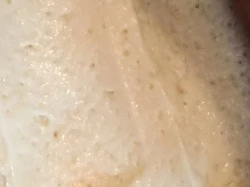
Here is a photo of my mayo after a few weeks in the refrigerator. I was surprised by a "foamy" sound when I scooped some out of the jar, and I looked closely and could easily see the bubbles formed by the fermentation process that continued in the refrigerator. I think that's really cool!
As a side note; there are usually not enough bubbles formed to see them, much less take a photo, so even if you cannot detect carbon dioxide formation, you can trust the process and know that fermentation has occurred.
As a side note; there are usually not enough bubbles formed to see them, much less take a photo, so even if you cannot detect carbon dioxide formation, you can trust the process and know that fermentation has occurred.
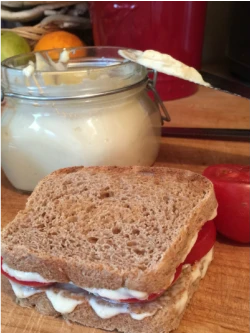
This has to be one of my favorite things to eat! I enjoy ripe tomatoes on real homemade whole wheat sourdough bread so much!
Refrigerated Mayonnaise and Gas Production
In my experience, refrigerated mayonnaise can produce tiny bubbles and a faint frothy sound, but the gas production has been minimal compared with vigorously fermenting vegetables. I recommend leaving the Airlock in place. If the mayonnaise is opened frequently, a Stopper may be a reasonable option, but pressure can accumulate if the Jar remains sealed. A Stopper should not be relied on for pressure relief or protection against jar breakage.